

Building Our Resilience
Resilience is the ability to face challenges and bounce back from tough times. It comes from the things we learn and the skills we build as we grow. Instead of giving up or avoiding problems, resilience means finding healthy ways to handle difficult situations as they arise. Developing a resilient mindset can help you become even stronger.
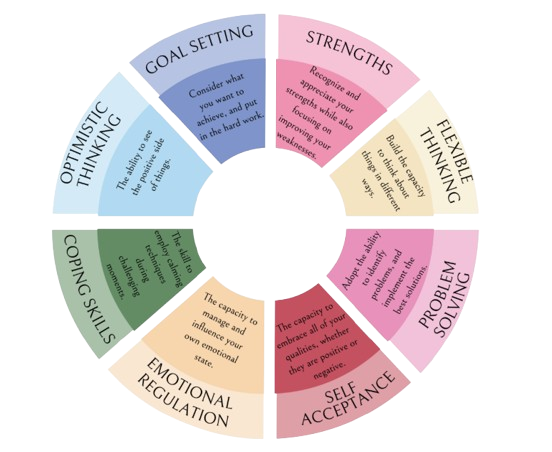
The resilience wheel shows eight important skills that can help you build the mindset and stay strong when life gets tough.
Goal Setting
Break down long-term goals into smaller, achievable steps.
Celebrate progress along the way and build momentum
Set SMART goals (Specific, Measurable, Achievable, Relevant, Time-Bound)
Goal Setting Example:
Specific: “I want to start my own business online selling handmade crochet on ETSY.”
Measurable: “I will set time every week to work on this and write out steps I need to accomplish this. I will share my progress with a close friend who has agreed to be my accountability partner.”
Achievable: “I will spend 1 hour on Sundays for working on this plan”
Relevant: “I have materials to sell, but I need to set time to work on the business aspect.”
Time-bound: “I will complete my plan to start my online business in 6 weeks.”
Each time you complete a step or achieve a milestone, celebrate! Every small step counts.
Ask yourself:
What is one long-term goal that you want to achieve and how can you break it down into smaller, manageable steps?
How will I measure my progress and celebrate to stay motivated?
Are my goals realistic and relevant to my current situation?
Strengths
Reflect on past challenges you have overcome and identify the strengths you used to get through them.
If you are struggling to identify your strengths, think of things you enjoy doing - what calls to you? What are things you feel you are good at or like doing?
Regularly practice activities that build on your natural strengths, such as volunteering or mentoring others in areas where you excel.
Ask yourself:
What past challenges have I overcome and what strengths did I rely on to get through them?
How can I use my strengths more regularly in my daily life through activities like volunteering or helping others?
Which areas of my life allow me to showcase my strengths and how can I continue to grow in these areas?
Flexible Thinking
Flexible thinking involves reframing negative situations by asking yourself, “what can I learn from this?” or “Is there another perspective on this situation that I can adopt?”
Embrace new perspectives by seeking out advice or opinions from others who you trust. This helps expand our thinking.
Ask yourself:
When faced with a difficult situation, how can I reframe it to focus on potential lessons or growth opportunities?
Is there a way that I can approach this challenge differently to find a more positive solution?
Important! Flexible thinking does not mean accepting abuse. For example, there is no “positive side” of being abused. Flexible thinking could be reframing your view of yourself, for instance admiring your strength to endure hard things and escape a bad situation, rather than thinking of yourself as weak.
Problem Solving
Approach problems step-by step by identifying the issue, brainstorming solutions, and evaluating the pros and cons of each option before deciding on what to do next.
When you are feeling overwhelmed, take a break and return with a clear mind. Maybe that means taking a walk, a nap, or a shower, and then returning to the problem with fresh insight.
Try to break solutions down into small achievable steps - just like with goal setting.
Identify the issue
Brainstorm solutions
Evaluate the pros and cons
Decide the course of action
Ask yourself:
What is the specific issue I need to address and how can I break it down into smaller steps?
What are some possible solutions to this problem and what are the pros and cons?
Is there someone I trust that I can brainstorm with?
How can taking a short break or stepping back help me gain fresh perspective on finding solutions?
Self-Acceptance
Cultivate self-compassion by recognizing that everyone makes mistakes and use setbacks as opportunities for growth rather than self-criticism.
Practice mindfulness to stay connected with the present moment and accept yourself without judgement.
Be kind to yourself! The more you practice self-acceptance the more resilience you will feel.
Ask yourself:
When I make a mistake, how do I usually react, and how can I shift my mindset to view it as a learning opportunity?
What are some aspects of myself that I struggle to accept, and how can I practice self-compassion in those areas?
How can I stay more present and mindful in difficult moments, allowing myself to embrace who I am without judgement?
Emotional Regulation
Develop calming techniques, such as deep breathing, progressive muscle relaxation, or grounding exercises, to manage overwhelming emotions.
Practicing mindfulness when we are not stressed will help us when we are stressed!
Journaling about your feelings can help you process emotions and gain perspective on situations.
By using these techniques you are managing your emotions in a healthy way, which allows you to handle difficulties with a clearer mind.
Ask yourself:
What calming techniques have I used in the past that helped me manage overwhelming emotions and how can I incorporate them into my daily routine?
How do I currently respond when I am feeling overwhelmed?
How can journaling or reflecting on my emotions help me understand my reactions to stress?
Coping Skills
Build a toolkit of positive coping mechanisms, such as exercising, talking to a supportive friend, or engaging in a creative hobby when under stress.
Practice stress management techniques like box breathing, mindful movement, walking in nature, meditation, yoga, etc. to improve your overall emotional resilience.
Ask yourself:
What positive coping mechanisms do I currently use when faced with stress and how can I expand my toolkit with new strategies?
Which stress management techniques (meditation, exercise, creative activities) help me feel the most grounded and how can I incorporate them into my routine?
How can talking to someone help me cope with a difficult situation?
Optimistic Thinking
Train your mind to focus on the positives by starting a gratitude journal where you list a few things you are grateful for each day.
Challenge negative thoughts when they arise by asking yourself, “is this thought based on fact or an assumption?”
Look for positives when you can, and notice if you are engaging in negative self-talk. Practice saying kind things to yourself or journaling about positive thoughts.
Ask yourself:
What positive aspects of my day can I focus on to shift my mindset and how can starting a gratitude journal help with this?
When negative thoughts arise, can I notice them and think to myself - is this a fact or assumption?
How can I reframe a recent challenging situation to view it with a more positive lens?